

Running Choo Choo Family Introduction
The Running Choo Choo Family has its roots in windups at the end of songs where the soloist dancer traditionally circles the stage, steadily building in energy and speed until she crescendos into a finale spin and pose. This family’s steps easily transition between and from each other to create dimension. Traveling while facing the outside of the circle in class emulates the dancer in a promenade sequence before a finale pose.
Imagine transitioning from FMMB to 1F1B to Running Choo Choo and then transitioning to one or more of the spins: Centrifugal, Out-Up-Out-Down, and In-Out. The sentiment of these steps is external, making them a good choice for parts of compositions where the dancer emotes outwardly and energetically to the audience
Descriptive Naming
Jamila chose the “Running Choo Choo” name to be descriptive. Just like a “choo choo train” (steam or internal combustion railway locomotive) moves powerfully and continuously over many miles, so do the steps in the Running Choo Choo family. Jamila wanted to convey to the student the need for strength, endurance, and grace to perform these steps seemingly effortlessly.
Direction
The Running Choo Choo Family is the only family that faces the outside of the circle. Jamila conducted classes with students moving in a CCW circle around the room. The Running Choo Choo family default steps travel right, so students face the outside of the circle travelinging CW. The Zenouba is the standard “exit” or “unwind” from the Running Choo Choo family where students still face outside the circle, but travel CCW. Trained instructors prepare students for the directional change in and out of this step family using Vocabulary call-outs and prompting.
Running Choo Choo Family Stylization
The default Running Choo Choo steps are defined by:
1) The foot position (one flat, one relevé).
2) The feet and hips having the same downbeat and timing.
3) The downbeat in opposition to the direction of travel.
The feet work through and within jazz 1st and jazz 3rd positions. Unlike the Arabic series, there is no “push off” stylization. The upper body anchors the steps. Stay controlled in Home Position to prevent yourself from bouncing.
Defaults, Variations, and Reverses
Default: downbeat left traveling to the right.
Variation of default: downbeat left traveling to the left.
Reverse: downbeat right traveling to the right.
Variation of reverse: downbeat right traveling to the left.
Running Choo-Choo
Many of the dancers in Egyptian cinema had a version of this step. Naemet Mokhtar who danced in movies of the 1950s had a signature variation in relevé doubletime with a demi on the primary downbeats.
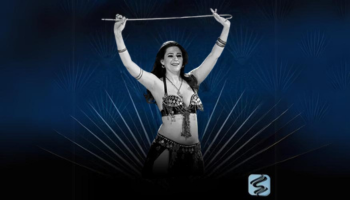
Running Choo-Choo was the entrance and thematic step of the original Bal Anat sword dance as well as the water glasses dance. Inspired by a Jean-Leon Gerome orientalist painting, Jamila developed a dance to be performed while balancing a Turkish sabre on the head. None of her students wanted to perform the piece, so Jamila performed it herself. The number was a hit, and dancers then were more interested in performing the piece.
From Faire to Cabaret
The first of her students to be a sword dancer in Bal Anat was Rhea, who went on to dance professionally and teach in Greece. The same dancers performing at the Faire would include the sword routines in their cabaret routines in the clubs at night, sometimes using double swords. The popularity of Bal Anat’s sword dance spread like wildfire through the United States throughout the 1970s.
Also for Bal Anat, Jamila introduced dancing on water glasses as one of the fantasy dances. Initially, Jamila performed this dance as a solo, sometimes combining it with the snake dance. Using 3 glasses, she would perform the Running Choo Choo by placing her left foot on two glasses and her right foot on the third. Jamila taught her water glass method in her classes, rotating dancers into that role in the show.
Definition
Travel right (left foot flat, right foot relevé) fulltime downbeat left (starting right on the upbeat), with alternating singles fulltime downbeat left. Arms in 4th position: right arm in 2nd and left arm in 5th.
Notes
- When learning, the foot placement easily morphs. Keep the feet and toes even and parallel.
- Flex and place cleanly with only one foot on the foot at a time.
- Stay steady without bounding.
4 Forward 4 Back (4F4B)
Definition
Running Choo-Choo; alternate stepping right foot (on the upbeat) forward for four steps and back for four steps.
Notes
- Keep the left foot stable while the right foot travels.
- Working through Jazz 3rd, step the right foot forward to 12:00cf and back to 6:00cf.
2 Forward 2 Back (2F2B)
Definition:
Running Choo-Choo; alternate stepping right foot (on the upbeat) forward for two steps and back for two steps.
1 Forward 1 Back (1F1B)
Definition:
Running Choo-Choo; alternate stepping right foot (on the upbeat) forward and back.
Forward Middle Middle Back (FMMB)
Definition:
Running Choo-Choo; alternate stepping right foot (on the upbeat) forward (12:00cf), middle (2:00cf), middle (4:00cf), back (6:00cf).
Notes:
- Working through Jazz 3rd, keep the feet right under your body. Place the right foot specifically.
- Suhaila added several variations that include adding half turns and full turns, both CW and CCW.
- Suhaila typically begins her discussion of threading with FMMB Threading is a type of transition where the dancer performs a personalized improvisation of the transition between steps maintaining the correct sentiment and vibe.
Running Choo Choo foot patterns in Suhaila Format
For her own format, Suhaila adapted the foot patterns from the Running Choo Choo family in many ways. She varied timing, foot placement, downbeat, and direction, as well as adding layering with pelvic and ribcage shapes.
Zenouba
The step was named after Zenouba, a professional belly dancer whom Jamila observed performing this step in the West Coast night clubs. The Zenouba is the standard “exit” or “unwind” from the Running Choo Choo family. Students still face outside the circle, traveling CCW. This step is also known as a grapevine, but Zenouba has specific stylization and sentiment.
Definition
Travel left, grapevine (flat ball ball ball) fulltime downbeat right, crossing the right foot forward over the left to begin. Arms in modified-2nd; forearms swing together parallel to the floor halftime downbeat right. Head looks halftime downbeat left.
Notes:
- The step alternates crossing forward, stepping open, crossing back, stepping open, etc. Emphasize the cross forward, but do not lose the cross in back.
- As you cross forward with the right foot, the body angles to the left front diagonal; as you cross back with the left foot, the body angles to the right front diagonal. The upper body has a controlled flurry or frenzy to the movement. The head movement is not just a “look”, but is connected to and in reaction to the upper body movement and energy.
- Keep the steps small. The movement is more about the upper body twisting and angling than the traveling.
The content from this post is excerpted from The New Danse Orientale: Salimpour Belly Dance Instruction, published by Suhaila International in 2013 with updates and additional content added in 2023. The New Danse Orientale is a study guide and resource for belly dancers when learning Salimpour Vocabulary steps and step families.
If you would like to make a citation for this article, we suggest the following format: Salimpour, J. & Salimpour, S. (2023). Running Choo Choo Family. Retrieved –insert retrieval date–, from https://suhaila.com/running-choo-choo-family
To print this blog post, click on the PrintFriendly button below and follow the instructions. Note: The PrintFriendly tool only works when using the Google Chrome browser.