

Persian Family Introduction
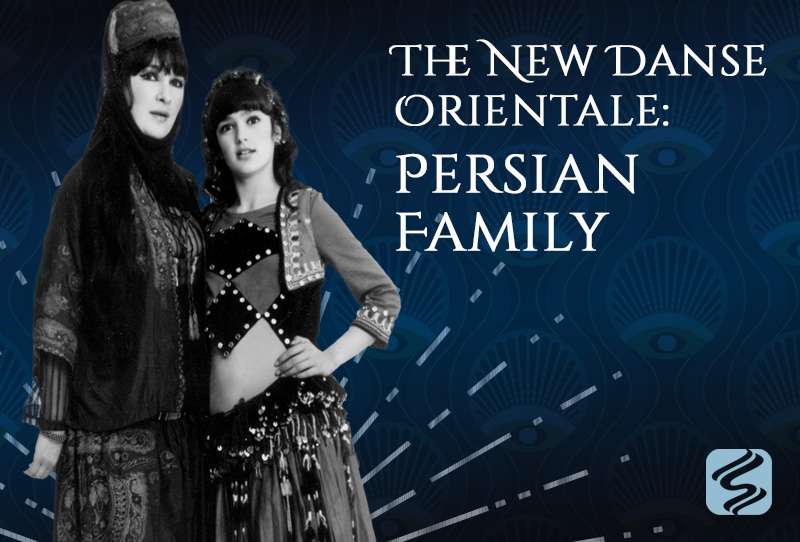
The Persian family of moves is based on Jamila’s and Suhaila’s research and observations of Persian women dancing in their homes or at social gatherings within their own family, from the greater Persian community in California, and throughout the world on Suhaila’s extensive travels.
The steps are characteristic of and named for the Persian people, the largest ethnic group in Iran, and are considered traditional. As with the Arabic Family steps, the women dance conservatively and demurely, and these moves reflect that sentiment.
Family Connections
Suhaila’s grandfather, Lotfallah, was a Kurdish religious Sufi leader. Along with his wife and children, he was forced by the Iranian government in the early 1900s to relocate and adopt the Shi’a branch of Islam. Knowing the family would be watched and potentially persecuted for any reversion to their original culture and religion, Lotfallah and his family integrated fully into a Persian community and became devout followers of Shia Islam.
The children were raised with Persian traditions and most married into the Persian community. Upon coming to the U.S., Lotfallah and his family maintained the traditions of their adopted culture and identified themselves as being Persian by ethnicity and Iranian by nationality.
These moves have default timings, downbeats, layering, directions, and sentiments. However, they can be varied. The key is to know the base move and to maintain the integrity of the footwork and Home Position.
Stylization
- For this step family, keep the feet close to the ground. When lifting and placing the feet, just barely lift the feet to give the appearance of shuffling or scuffling along the floor. Deliberately place the feet without stomping. The foot patterns are small.
- Foot placement is essential for this step family, so maintain the exact foot positions despite the direction traveled. To find the correct foot placement for Persian 1-3, stand in jazz first with the right foot flat and the left foot on the ball. Move the left foot slightly back so that the ball of the left foot is parallel to the heel of the right foot. The back foot does not tuck but stays by the heel of the front foot. Push off the back foot to travel forward.
- The typical arm positioning bends one arm with the power finger at the eyebrow and extends the other arm in modified-second.
- The Persian steps have a subtle bounce that slightly emphasizes up when on the ball of the foot and down when on the flat foot.
Persian 1
While Persian 1 appears similar to Arabic 1, the two steps have distinct differences. In addition to different arm placement and slightly different foot placement, Persian 1 has a slight bounce and no undulation.
Definition
With right foot flat; left foot on the ball and slightly behind right foot. Travel forward (flat-ball-flat-ball) fulltime downbeat right with a subtle bounce that slightly emphasizes up when on the ball of the foot and down when on the flat foot. The left arm is bent with the power finger at the eyebrow and the right arm is extended through modified-2nd. Lean or bend your upper body to the right side, drop the right shoulder down and slightly forward, and look to the right diagonal.
Notes
- Do not press your hips forward or rock your pelvis.
- To find the correct foot placement for Persian 1-3, stand in jazz first with the right foot flat and the left foot on the ball. Move the left foot slightly back so that the ball of the left foot is parallel to the heel of the right foot. The back foot does not tuck but stays by the heel of the front foot.
- A common stylization adds a shoulder shimmy doubletime or quadrupletime.
Persian 2
Persian 2 is different from Persian 1 in two ways: 1) a subtle change in the footwork from flat-ball-flat-ball to flat-ball-ball-ball, and 2) the addition of an interior hip circle.
Definition
Persian 1 with flat-ball-ball-ball footwork and an interior hip circle CCW fulltime downbeat right. The circle has a slight emphasis on the downbeat.
Persian 3
Persian 3 and Khaleegi 3 have the same footwork, so the family stylizations are important to responsibly differentiate the steps.
Definition
Persian 1 traveling forward with alternating chasse (flat-ball-flat) fulltime downbeat right. The arms alternate Persian 1 arms halftime downbeat right. The extended arm coordinates with the foot leading the chassé on each side.
Persian 4
Arabic 4, Persian 4, and Khaleegi 4 have the same footwork, although the timings, hipwork, and family stylizations are different.
Definition
Walk forward-and-back-and flat halftime downbeat right with figure eights front-to-back halftime downbeat right and arms in a relaxed modified-second with subtle shoulder presses halftime downbeat right. The step has a very subtle bounce fulltime with a focus down on the downbeat.
Notes
- A common stylization adds a subtle demi plie as you step back on the right foot.
Persian 5
Persian 5 is related to CCW Pivot Fulltime footwork. In Persian 5, the footwork is downbeat right, but the turn is still CCW.
Definition
With right foot flat, left foot in relevé, paddle turn CCW fulltime downright right by lifting right heel as left foot follows.
Shoulder presses doubletime downbeat right with arms in modified-second. As you lean your upper body to the right side, drop the right shoulder down and slightly forward, and look to the right diagonal.
Persian 6
To capture the right energy for Persian 6, imagine you are wearing a long heavy skirt that you are swishing to the timing.
Definition
With feet flat in jazz 1st.
- Put your weight on the balls of your feet and swivel both heels to the right [1].
- Put your weight on both heels and swivel both balls of your feet to the right [2].
- Swivel on the balls of your feet and bounce your heels RLR [3&4].
- Continue pattern on the left L-L-LRL [5, 6, 7&8].
Alternating soft contraction twists (without glutes) following the feet R-L-RLR [1, 2, 3&4] and L-R-LRL [5, 6, 7&8]. The chin follows the movement RLR [1, 2, 3] and LRL [5, 6, 7].
Arms are in low first about 6” apart with fingertips down and palms facing your sides. Tilt the right hand down releasing the right shoulder to angle forward and then the same on the left. Alternate the shoulders in timing with the feet and hips R-L-RLR [1, 2, 3&4] and L-R-LRL [5, 6, 7&8].
The content from this post is excerpted from The New Danse Orientale: Salimpour Belly Dance Instruction, published by Suhaila International in 2013 with updates and additional content added in 2023. The New Danse Orientale is a study guide and resource for belly dancers when learning Salimpour Vocabulary steps and step families.
If you would like to make a citation for this article, we suggest the following format: Salimpour, J. & Salimpour, S. (2023). Persian Family. Retrieved –insert retrieval date–, from https://suhaila.com/persian-family
To print this blog post, click on the PrintFriendly button below and follow the instructions. Note: The PrintFriendly tool only works when using the Google Chrome browser.