


Belly Dance Online
Learn • Subscribe • Certify
No Result
View All Result
Suhaila.com
  • Home
  • About
    • Meet Suhaila
    • Salimpour Legacy
    • Testimonials
    • Contact Us
    • Study with Suhaila
  • BLOG
  • Topics
    • Welcome to Fundamentals 1
    • Salimpour Compendium
    • The Story of Bal Anat
    • Jamila’s Article Book
    • Danse Orientale
    • Middle Eastern Music Guide
    • Belly Dance Resources
  • Events
  • Learn Belly Dance Online
  • Certify in Belly Dance
  • Be a Licensed Instructor
  • Join the Online Institute
  • Home
  • About
    • Meet Suhaila
    • Salimpour Legacy
    • Testimonials
    • Contact Us
    • Study with Suhaila
  • BLOG
  • Topics
    • Welcome to Fundamentals 1
    • Salimpour Compendium
    • The Story of Bal Anat
    • Jamila’s Article Book
    • Danse Orientale
    • Middle Eastern Music Guide
    • Belly Dance Resources
  • Events
No Result
View All Result
Suhaila.com

One Thousand and One Arabian Nights

Suhaila.com by Suhaila.com
April 5, 2024
in History & Culture, Salimpour Compendium
Reading Time: 5 mins read
One Thousand and One Arabian Nights
Share on Facebook

The tale of Sheherezade is part of the collection of folktales from the Middle East and Western Asia compiled in between the 8th and 13th centuries known as the One Thousand and One Nights, sometimes called the Arabian Nights Entertainments, or by its Arabic name, Alf Layla Wa Layla. The main frame story concerns a Persian king who discovers that not only has his brother’s wife been unfaithful, but also his own new bride. The king has his wife executed and decides that all women are adultresses and not to be trusted. He then marries a succession of virgins every day only to execute each one the next morning. Eventually his vizier can not find any more virgins, and the vizier’s daughter, Sheherazade, offers to marry the king. The vizier reluctantly agrees. On the night of her marriage to the king, Sheherazade begins to tell him a story, but stops her story-telling at sunrise. The king, at first angry, agrees to wait until the next night to hear the rest of her tale, but she continues to leave her tales unfinished, night after night, for 1,001 nights. Some of the most famous tales include “Aladdin and the Wonderful Lamp,” “Sinbad the Sailor,” and “Ali Baba and the Forty Thieves.”¹ 

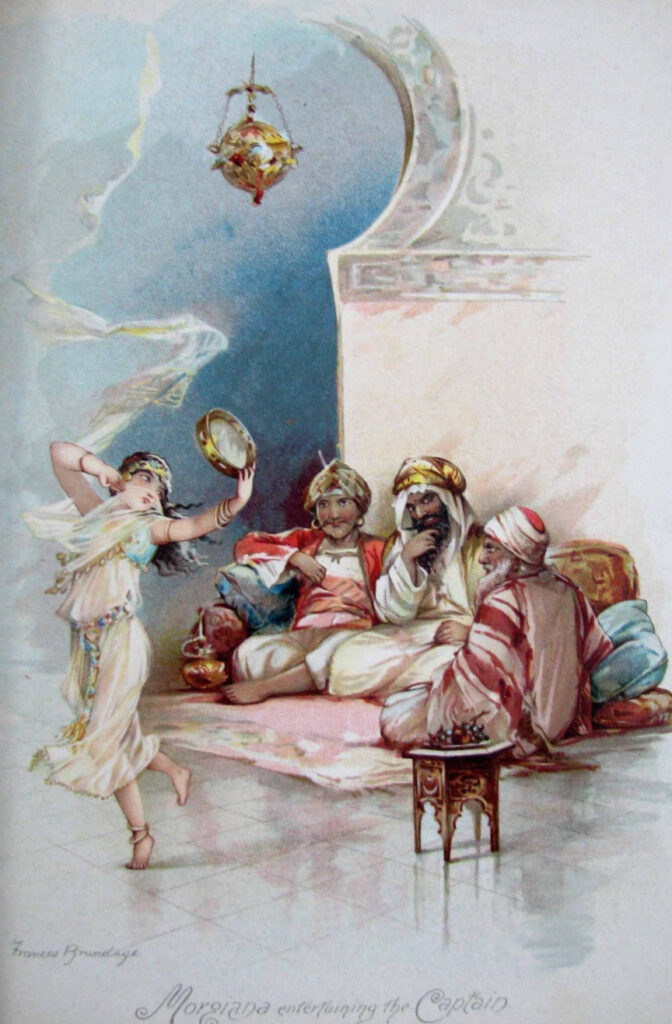
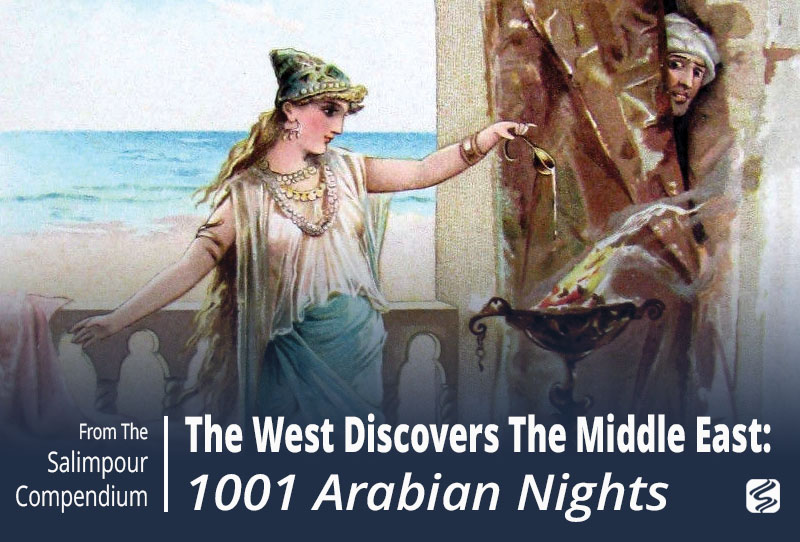
Morgiana Entertaining the Captain, Color Plate by Frances Brundage from The Arabian Nights (1890)
Morgiana Entertaining the Captain, Color Plate by Frances Brundage from The Arabian Nights (1890).

The tales have been transformed as they have been told through the years, both in the Middle East and in Europe. They were first transmitted orally, then were combined and written for the first time in Iraq around the 10th century.² The stories were first introduced to Europe through the French translation by Antoine Galland in the early 18th century. The ten volume translation by Sir Richard Francis Burton, however, is perhaps the most famous, as it emphasized and exaggerated the tales’ sexual elements, scandalizing his Victorian readership. Burton’s liberal translation likely contributed to the Western perception of Arabs as being immoral and savage; indeed, scholar Rebecca Stone comments that Victorians considered the tales in their original form to be unfit “reading for women and for young people.”³ In 1899, J. C. Madrus’ created his own translation, published in serial volumes over the course of five years; this new translation, combined with Salomania and a surge of interest in all things Oriental, imparted Middle Eastern influences on fashion and decorative arts.⁴ 

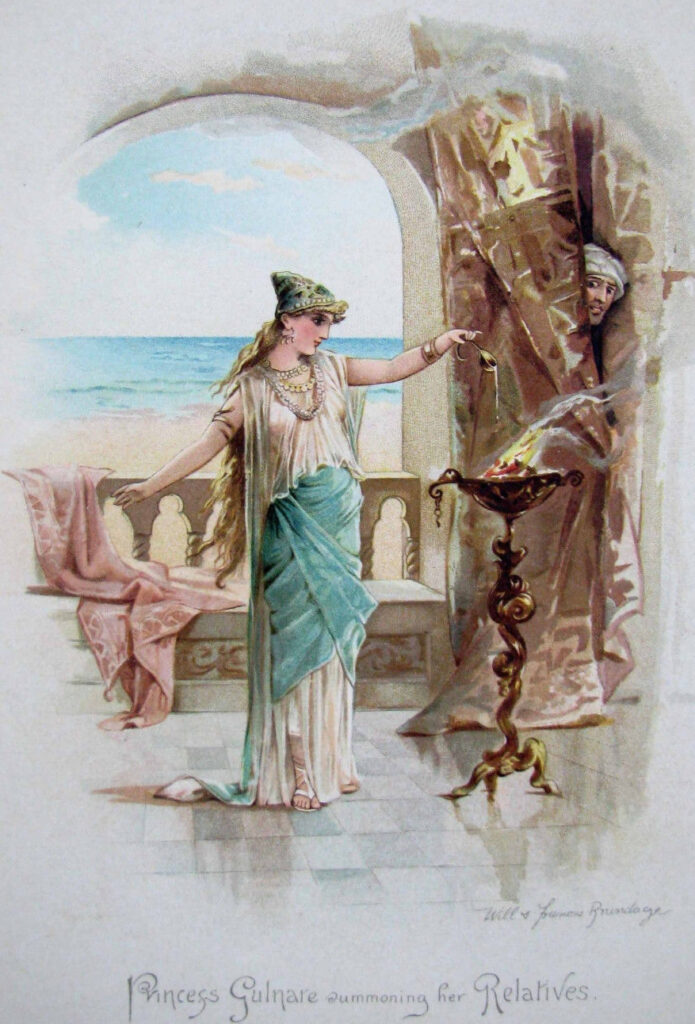
Princess Gulnare Summoning her Relatives, Color Plate by Frances Brundage from The Arabian Nights (1890)

The tales have been immensely influential on the West’s perception of the Middle East and the people that live there. For many 19th-century European travelers to the Middle East, their only exposure to the region was through the stories of One Thousand and One Nights. The Nights, however, portray a timeless, fantasy “Orient,” just as Western fairy tales do of Europe. Scholar Judy Mabro notes that in her research for her anthology of writings from European travelers in the Middle East that the “image of the flamboyant, erotic and cruel Orient was applied indiscriminately to a large geographical area,” regardless of whether they were in Baghdad, Algiers, or Cairo (cities with quite different histories, dialects, architecture, and cultures).⁵ Davinia Caddy also says that as more people had access to various translations of the One Thousand and One Nights, its readership began to “perceive this imagined ‘Other’ land as a place of fantasy displaced from the body politic of the West—an arena of free, absolutist, erotic constructions.”

⁶ This homogenous fantasy land has influenced the image of the Middle East in the Western consciousness, arts, and media, from images of sheikhs, harem girls, genies, camel caravans, and magic lamps. In addition to influencing Western stage arts—such as the “Oriental” dances of the Ballets Russes—scholar Stone rightly points out that the popularity of the tales of the One Thousand and One Nights in Hollywood, from films such as The Thief of Baghdad (1924), The 7th Voyage of Sinbad (1958), and Disney’s Aladdin (1992) have all reinforced these tropes.⁷ In recent years, newer translations of the original tales from Arabic to English have been more faithful to the source material, as that by Husain Haddawy, published in 2008.

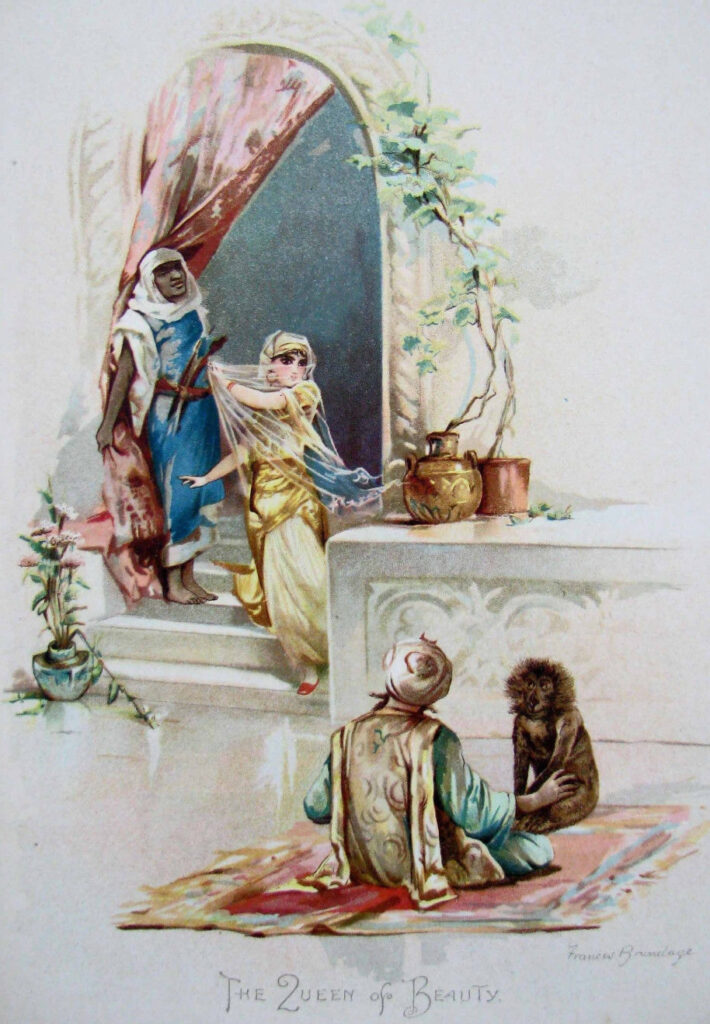
Queen of Beauty, Color Plate by Frances Brundage from Burnside, Helen Marion, Arranger, The Arabian Nights. London: Raphael Tuck & Sons (1890)
Queen of Beauty, Color Plate by Frances Brundage from Burnside, Helen Marion, Arranger, The Arabian Nights. London: Raphael Tuck & Sons (1890).
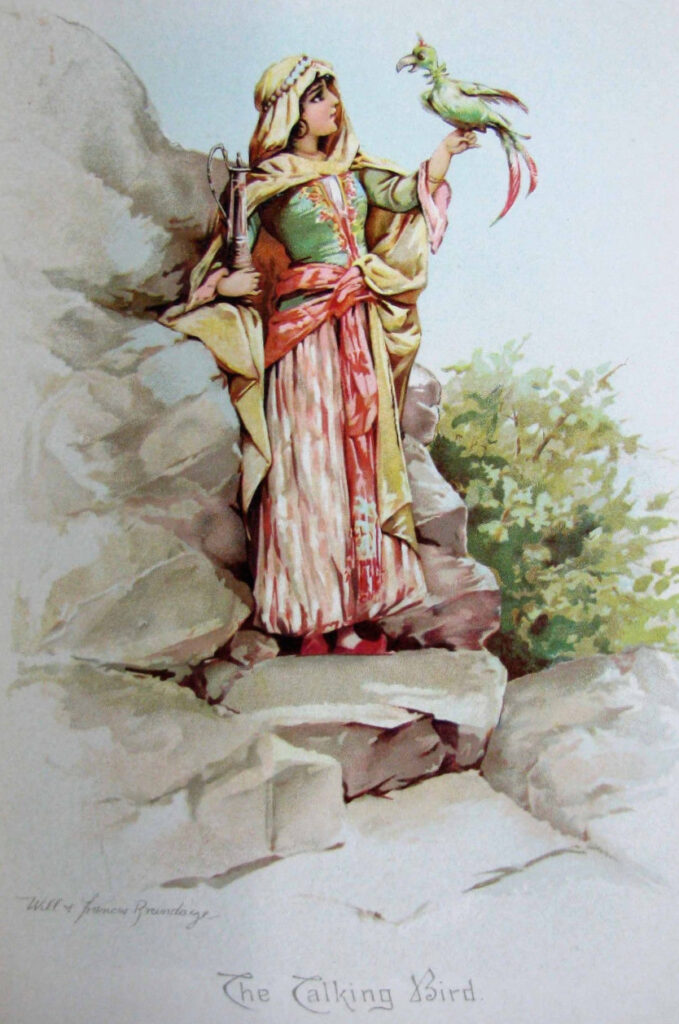
The Talking Bird, Color Plate by Frances Brundage from The Arabian Nights (1890)
The Talking Bird, Color Plate by Frances Brundage from The Arabian Nights (1890).

The content from this post is excerpted from The Salimpour School of Belly Dance Compendium. Volume 1: Beyond Jamila’s Articles. published by Suhaila International in 2015. This Compendium is an introduction to several topics raised in Jamila’s Article Book. 

If you would like to make a citation for this article, we suggest the following format: Keyes, A. (2023). One Thousand and One Arabian Nights. Salimpour School. Retrieved insert retrieval date, from https://salimpourschool.com/

1 Interestingly, these three were not a part of the original Arabic tales, but are almost certainly authentic folk tales from the region. French translator Antoine Galland added them to the compendium of tales later in his own volume.

2 Margaret Sironval, “The Image of Sheherazade in French and English Editions of the Thousand and One Nights (Eighteenth-Nineteenth centuries),” The Arabian Nights and Orientalism: Perspectives from East and West, ed. Yuriko Yamanaka and Tetsuo Nishio (London: I.B. Taurus, 2006), 219.

3 Rebecca Stone, “Reverse Imagery: Middle Eastern Themes in Hollywood,” in Images of Enchantment: Visual and Performing Arts of the Middle East, ed. Sherifa Zuhur (Cairo: American University in Cairo Press, 1998), 249

4 Davinia Caddy, “Variations on the Dance of the Seven Veils,” Cambridge Opera Journal, 17:1 (March 2005): 47.

5 Mabro, Veiled Half-Truths, 28.

6 Caddy, “Variations,” 47.

7 Stone, “Reverse Imagery,” 250.

Pillar page
Print Friendly, PDF & Email(Print feature only usable with Chrome)
Previous Post

Western Travelers in the Middle East 

Next Post

Egyptomania

Suhaila.com

Suhaila.com

Related Posts

Feminism and Belly Dance

Feminism and Belly Dance

by Suhaila.com
April 5, 2024
0

Many women (Western and some Middle Eastern) who practice belly dance ascribe to the ideas of the dance being empowering,...

Male Belly Dancers in the United States

Male Belly Dancers in the United States

by Suhaila.com
April 5, 2024
0

While American audiences might have sought out the nightclubs to see women dance, there were many men who became involved...

Middle Eastern Nightclubs in the United States

Middle Eastern Nightclubs in the United States

by Suhaila.com
April 5, 2024
0

The era of the Middle Eastern nightclub in the United States stretched from the early 1950s to the early 1970s,...
The Veil

The Veil

by Suhaila.com
April 5, 2024
0

The Veil as Dance PropThe veil as we know it in belly dance—a three-to-four yard of lightweight fabric used as...
Oriental Images in Hollywood

Oriental Images in Hollywood

by Suhaila.com
April 5, 2024
0

Jamila was very much against the Hollywood image of the belly dancer; she felt American films took the stereotype entirely...
Orientalism: A Primer for Practitioners of Oriental Dance

Orientalism: A Primer for Practitioners of Oriental Dance

by Suhaila.com
April 5, 2024
0

The term “Orientalism” holds within it a multitude of meanings from benign to controversial. Many scholars have dedicated insightful papers,...


Next Post
Egyptomania

Egyptomania

SuhailaInternational_Logos®_SuhailaIntl_Logo
  • Terms of Use
  • Privacy Policy
  • Inclusion Policy
  • Harassment Policy
  • Institute Policies
No Result
View All Result

SHORT COURSES

CLASSES

  • Home
  • About
    • Meet Suhaila
    • Salimpour Legacy
    • Testimonials
    • Contact Us
  • Belly Dance
    • Welcome to Salimpour School
    • Learn Belly Dance Online
    • Certify in Belly Dance
    • Be a Licensed Instructor
    • Join the Online Institute
    • Study with Suhaila
  • Blog
  • Topics
    • Welcome to Fundamentals 1
    • Salimpour Compendium
    • The Story of Bal Anat
    • Jamila’s Article Book
    • Danse Orientale
    • Middle Eastern Music Guide
    • Belly Dance Resources
  • Events