
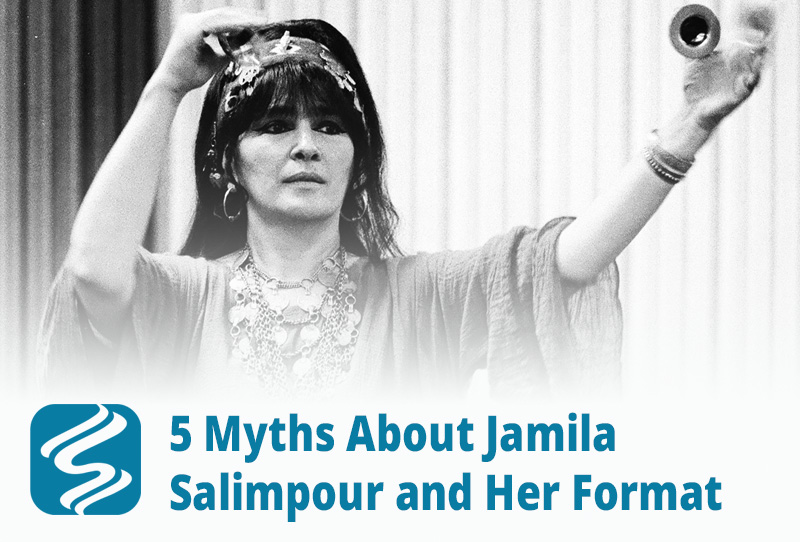
Of course, we’re a little biased, but we think that Jamila Salimpour’s Vocabulary revolutionized belly dance practice, teaching, and understanding around the world. She and her daughter’s careful cataloging of steps by dancers from a diverse range of styles and regions have left us with a versatile and comprehensive collection of movements. But when you’re as influential and sometimes controversial figure as Jamila was, a few myths are going to pop up. Here are some of the biggest myths about Jamila and her belly dance Vocabulary.
1. Jamila was “American.”
While Jamila herself was born in the United States, it’s important that we remember that she was the daughter of Sicilian/Greek immigrants. She grew up in an isolated Sicilian immigrant enclave in Harlem. She didn’t speak English until she was five years old. Sometimes she’s referred to as “American,” with the implication that she was just another hippie doing belly dance in the 60s.
Sicilian culture at the turn of the century had many affinities with North Africa. After all, you can see Tunisia from the Italian island. And the little city state has been a cultural and trade crossroads for centuries. It’s easy to think of it as “Italian,” but even after unification in the mid-19th-century, many of the cultural enclaves in the country preserved their customs and dialects.
The cultural norms, superstitions, and ethos of Jamila’s Burzi family certainly had more affinities with Eastern Mediterranean culture than generic white American culture. And when she moved to Los Angeles, she was welcomed into the many immigrant communities there. These included Arabs, Greeks, Persians, Turks, and Armenians. She was hardly “American” in the generic, Leave it to Beaver sense of the word.
2. The Jamila Vocabulary is easy
Some people want to take the Jamila Vocabulary and not take the Suhaila Format. One of these reasons is that they think that the Jamila Vocabulary will be easier. After all, many of the steps are familiar, and most dancers have done some variation of a few of them. But it challenges your posture, technique, stamina, musicality, listening, and endurance. And there are far more steps than most people realize. In the 100 level, there are 20 steps in just the Basic Egyptian Family. This isn’t to try to drive people away from the Vocabulary. It’s difficult because the standards are high, just as Jamila wanted.
3. The Jamila Vocabulary is “tribal style”
Of course, Jamila and Bal Anat are often mentioned in the same breath, as they should be. The long-running dance company is one of her most visible and influential legacies. And Bal Anat was often considered the first “tribal style” belly dance company because of its look and feel. Even today, the cast wears rich colors, textiles, and heavy jewelry, which had been adopted by dancers later on who called themselves “tribal” styles.
Each dance in Bal Anat is performed by a group of dancers. The rest stand in half circle behind them, much like the classical corps de ballet or even a bit like a hip hop cipher circle. But the format itself is not “tribal style” belly dance in the way that the term has evolved to mean for us in the 21st century.
In addition, the belly dance world is realizing that the term “tribal” isn’t appropriate for what they do anyway. The steps in Jamila’s Vocabulary are quite versatile and are drawn from a variety of stylizations, regions, and time frames. The Basic Egyptian Family, for example, is far closer to the Golden Era Egyptian cinema dancers than the 1990s improvised group belly dance. This is because that’s where Jamila first studied those movements. So while many improvised group belly dances (and other extemporaneous group styles) use Jamila Vocabulary steps as a foundation, like Basic Egyptian, Counter-Clockwise Pivot, and Running Choo Choo, the format as a whole is not limited to “tribal style”.
4. The Vocabulary is “old school” or “vintage”
In the belly dance scene, particularly in the fusion community, there seems to be a sense that Jamila’s format is stuck in a certain time period, that is, the 1960s and 1970s. It’s true that Jamila and her dancers were quite active at this time, and that the format itself sets a historic cut-off at 1978.
But dancers who aren’t in the school sometimes describe their use of Jamila Vocabulary as “old school” or “vintage.” It’s so much more than that. These are classic belly dance steps that can be used in a vintage context, but they can also be used in contemporary-style performances. In fact, I’m sure you use many steps in the Jamila Vocabulary in your contemporary-style performances, like Basic Egyptian, 3/4 Shimmy, Arabic 2, and Choo Choo. (Please don’t say “Chooch.”) Let’s not fossilize the Jamila Format to one specific time and era, because it is so much more versatile than that.
5a. You can do the Jamila Vocabulary without doing Suhaila Format
The Suhaila Format is the technical foundation, which also includes the fundamental terminology, nomenclature, and timing notation. We use this spoken and movement language to break down movements in the Jamila Vocabulary. If you don’t understand these elements, assimilating the Jamila Vocabulary movements into your mind and body is going to be far more difficult. The Salimpour School recommends that you take Suhaila Format of each level first. This progression will make far more sense. Accordingly, you’ll be less overwhelmed as you progress through the levels. Hope to see you in one of our many workshops this year!
5b. The Vocabulary was created only by Jamila Salimpour
There is a misconception that the Vocabulary was researched and compiled only by Jamila. Suhaila contributed steps to most of the families, accounting for nearly half of the steps. In fact, Suhaila is responsible for the fundamental posture, known as Home Position.
The original blog was published in the Salimpour School blog on 23 Jan 2020. It was updated 2 Oct 2023.